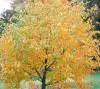
Tree ID: 64
Height: 50-70'
Diameter: 18-24"
Latin Name:
Betula allegheniensis
Common Name:
Yellow Birch
Type of Tree: Shade
Type of Wood:
Description:
Yellow birch, is a large, long-lived, deciduous tree native to to cool, rich forests, wooded streambanks and swamps in eastern North America. Its range extends from Newfoundland, Nova Scotia, and New Brunswick west through the Great Lakes region to Minnesota, and south through the southern Appalachians. It is most common in the northern portions of its range and is only found sporadically in the southern United States at higher elevations, on north facing slopes, and in cool, moist gorges. Mature trees will reach 60-75′ tall with a similarly wide, irregularly rounded to spreading canopy. Some wild specimens will occasionally reach up to 100′ tall.
The bark is shiny and yellow-grey in color with thin, exfoliating strips and dark, horizontal lenticles. Mature trunks develop scale-like, grooved plates. The twigs have a slight wintergreen scent when crushed. The foliage is narrowly ovate with doubly serrated margins and will reach 2.5-4″ long and 1.25-2″ wide. In fall the leaves turn bright golden yellow. Light green, 2″ long male catkins are formed in late summer at the ends of the twigs in clusters of 2-6. In spring they elongate to 3-4″, turn purple-yellow, and become pendulous while shedding pollen. The solitary, green, 1″ long, oval-shaped, upright female catkins emerge near the ends of the branches in spring. The fruit is a small, light brown, winged nutlet that are dispersed in fall and winter.
The seeds are an important food source for small mammals including squirrels and mice, game birds including ruffed grouse and turkeys, and songbirds including chickadees, finches, and juncos. The wind-dispersed seeds produce an abundance of seedlings which are browsed by deer, moose, and rabbits. The leaves are a larval food source for many species of butterflies and caterpillars.
Photo Gallery